01FIELD VALIDATION
Fire response
Cooling, suppression, exposure protection and reignition control.
- FIRST PROOF
- Matched-source comparison
- NEXT DECISION
- Repeatability and field integration
 Partner with us
Development portfolio
Fire response leads commercialization. Industrial and selective applications advance only through specific validation gates.
Industrial image is illustrative; application performance remains to be validated.Propose a validation duty →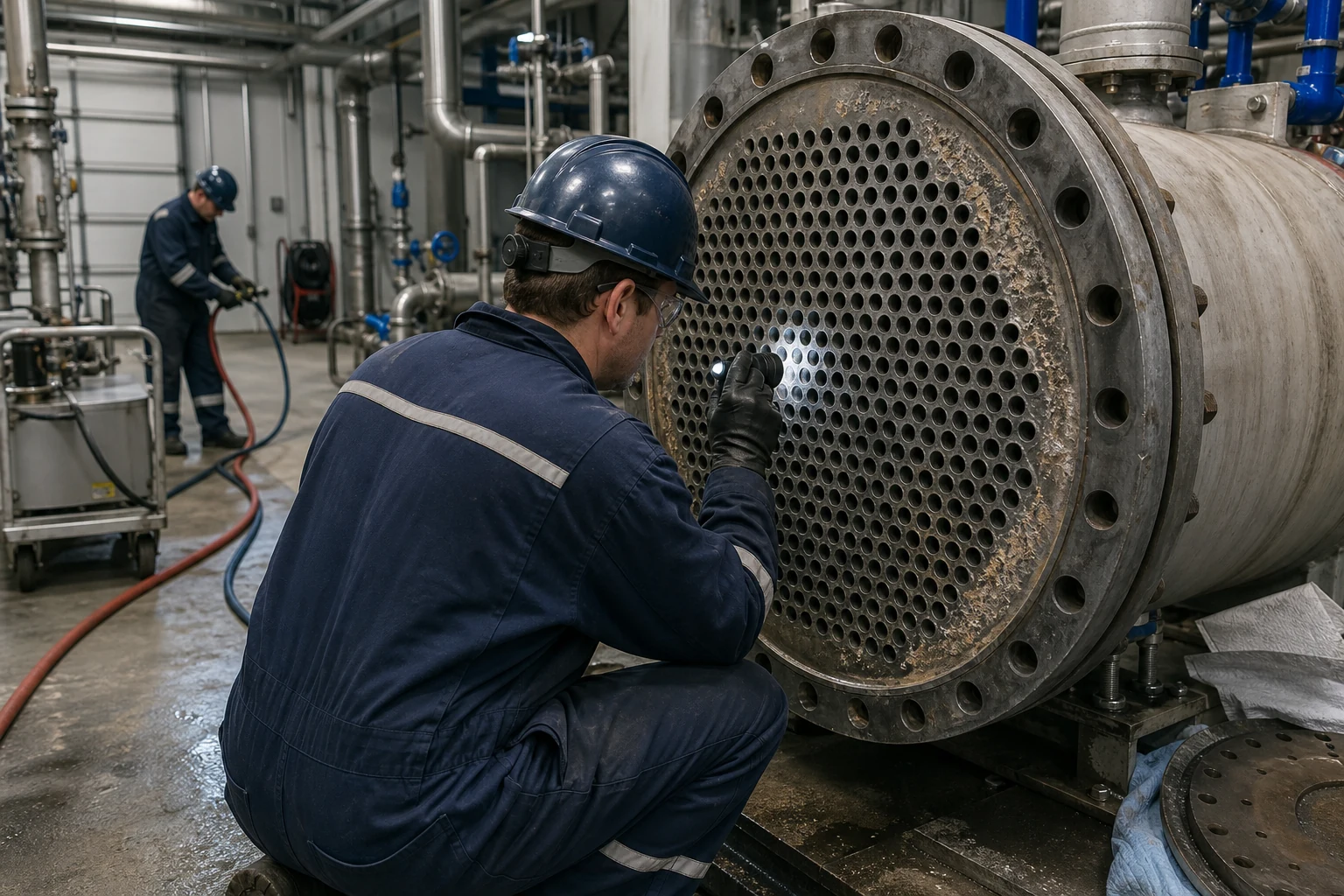
Portfolio discipline
Every program starts with a defined duty, a relevant control and a measurable outcome. Maturity labels make the status and next decision explicit.
Cooling, suppression, exposure protection and reignition control.
Defined heat-exchanger, piping and boiler-tube duties subject to compatibility and performance testing.
Bounded screening where carbonic solution may reduce reliance on stronger mineral acids.
Industrial development
Materials, deposits, geometry, flow, temperature, safety requirements and downtime costs shape the validation plan. SC Technologies is seeking bounded duties where performance can be measured responsibly.
Discuss a validation opportunity →Operating value
These are categories to measure—not claimed savings. Adoption depends on the whole operating picture.
A useful first brief
A strong application conversation starts with the operating facts—not a broad claim. Bring these four inputs and SC Technologies can help frame the first validation question.
Equipment, geometry, materials, temperature, flow and safety constraints.
Current chemistry, method, cycle time, water use and known operating burden.
A measurable technical result tied to a real operational decision.
Decision owner, test environment, timing and route to implementation.
Application gate
An application advances only when all three questions have credible answers.
Measure the effect against a relevant control.
Assess materials, safety, delivery and field constraints.
Define customer value, partners and route to market.
Advance the work with us.
Industrial operators · OEM partners · Maintenance teams · Applied researchers